Monday, June 6, 2011

Hand pollination works!

The very simple technique of hand pollination works!

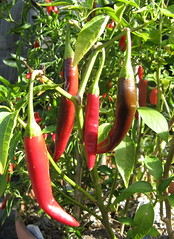
Taken last 19-May-2011, see the picture. I will take care of my chili plants, then do hand polination, so I get the pods.


Till then!
Enhanced by Zemanta

Sunday, May 15, 2011

No chili pods yet, but have sweet potato shoots!

While I am waiting for the chili pods to come out, if ever my hand-pollination technique using a round paintbrush is ever successful, what I see coming out from the potted soil are a number of shoots from my chopped-off end of sweet potato root crops buried beneath were alive - and growing!

I resorted to this method because the leaves they sell don't include the stems where new shoots could grow, and also since I like very much the Japanese sweet potato variety, I decided to chop off some ends every time my wife buys some. And if I am the one doing the marketing chore, I would pick up some loose ends, broken ends of these sweet potatoes, and would simply just show them to the clerk at the check-out counter, and she would smile and let me go off this 3 or 4 of these.

That's only twice, if I recall correctly. Just the few pieces that I need to start off my sweet potato farm.

So while I'm waiting for the pods to come out, I'm seeing purple stems and leaves shoot up.

So now I see some colors other than green and white. And I am looking forward to some boiled sweet potato shoots dipped in vinegar and anchovies. Yum!

Till then!

Enhanced by Zemanta

Sunday, May 8, 2011

Hand pollination

Pollination01Image via WikipediaI have come across several articles in the web for doing manual pollination. Some suggested paint brush use, just the size enough for the flowers to be inter-pollinated, and some others suggested the use of cotton buds.

I chose the paint brush, as I always have these within my reach, and I don't have to throw them away after use.

Now, all I have to do is wait. I hope to be successful in my manual pollination technique!

Till then.

Enhanced by Zemanta

Wednesday, May 4, 2011

No pollinators

chiliPollinatorImage by cskk via FlickrThe chili plants that brought me high hopes as my provider for leaves and pods - they all grew well. But it is just so disappointing, in that living up high in the flats among an almost concreted area will not have even a single pollinator!

The flowers come, sprout, spread, then wither and die. No pods.

And the leaves are almost always having some aphids sticking underneath them. I wouldn't have minded that for all I care, but then, there are no fertilized flowers that will show me some colors other than green and white, so I would be on the lookout on how to perform artificial pollination.

I hope to make this work - many flowers are waiting!

Till then!

Enhanced by Zemanta

Saturday, April 2, 2011

One of my phals

Here is a picture of my yellow phal. I really thought that it was very difficult to take care of this mysterious orchid, but I was wrong. It is even easier to take care of than a dendrobium. Just bright light and a continuous breeze whole day, and the watering can go from weekly to bi-weekly. And they will thrive.

Here goes!

DSC_0992-1

Enhanced by Zemanta

Wednesday, March 2, 2011

Good books on Orchids

Orchid Basics (Pyramid Gardening)I borrowed some books from the library, and there are three that I can recommend to anyone who is just beginning, or is already an expert, on orchid cultivation.

it can serve the purpose of clearing doubts, or correcting assumptions, or gleaning new nuggets of wisdom. There are always new things (if we can call them new) every now and then.

So here goes:

Orchid Basics   
A comprehensive guide to care and cultivation
by Brian & Sara Rittershausen

  • very simple and easy to grasp explanation on how to go about with orchids
  • shows by photograph how to perform hybridization (first book that I "see" how to hybridize), and believe me, it is very, very complicated (if you now what I mean)!

Orchids to Know and GrowOrchids to Know and Grow
by Thomas J. Sheesan and Robert J. Black

Growing Orchids in your garden
by Robert G. M. Friend
  • emphasizes growing orchids in their natural habitat
  • tells where each variety is originating, where found

Growing Orchids in Your GardenI intended to supply only a few words on the books, as I want you to know the good merits from these books - firsthand.

Will you share when you're done reading?

Till then!

Enhanced by Zemanta

Tuesday, January 25, 2011

New terms, new skills

Oncidium varicosum OrchidImage via WikipediaI am coming across many words that I do not use every day, or, to say it more accurately, I have been away from for so long. I have stopped doing gardening, and the technical terms to correctly describe this and that, and all things about plants and their care is, well, they’ve been away from me, too.

But after reading some books, and going through a lot of articles in the web, I am slowly but steadily gaining back the knowledge needed to get me through.


Terms:

Here are some terminologies that I’m sure are common to those who do and describe them every day.

Heft – to carry with the purpose of weighing: Heft the pot to see if it is heavy with water or not.

Leach – filter through, pass through: Leach the pot to get rid of extra water or fertilizer.

Adventitious – by chance and not an integral part: Orchids not at the right flowering environment may come up with adventitious growths rather than flowers.

Incipient – only partly in existence; imperfectly formed: If an orchid isn’t given the proper treatment during the period of rest, incipient flower buds will undergo a drastic change.

Pseudobulbs and Canes – Specifically applied to orchids, a cane is like a slender stick, while a pseudobulb is like a hand pump, flattened at the ends. Both are for storing water, but the pseudobulb acts like a reservoir. Therefore, use this to determine if you will water your orchids twice a week, or only once. Of course, this is the general guide.


Skills:

Here are also some skills that you would sure make use of, if you aren’t doing already.

Misting using a spray – Instead of using a shallow bowl or a separate pot serving the same use to induce humidity by filling up with pebbles and water around or below the orchid pots, induce humidity by misting the leaves and roots 2x daily.

Under the sun, out of the sun – growing orchids are placed under the sun, or given their dappled light, or whatever is suitable to your variety of orchid, but when the flowers are out, they only need the bright light, and not the sunlight. Again, this is the general rule.

Growth and rest periods – orchids in general are following a seasonal cycle. When growing, they are provided with the necessary sunlight or bright light, humidity, fertilizer, etc, most of which are cut back when the leaves fall (as in the case of dendrobiums) and the plants go to rest.

A leafless cane is not a useless cane – part of their growth (how can dropping leaves be called ‘growth’?) is to shed old leaves and become dormant for a time. This is to process the remaining nutrients they have stored, in order to use up for new flower buds or new growths. So don’t throw away that orchid simply because all the leaves have fallen. Like the Resident Evil phrase, it may talk back: “Hey! I’m not dead yet!”

Recipe for death for a hard cane Dendrobium – If we are all looking for ways and means to be able to care and make our dendros grow and flower well, one article indicated the recipe to kill a hard cane dendro: Wet and cold. Dendros can take a momentary wetness, or a momentary coldness. But both happening at the same time, being wet and cold, well, that will kill the dendro.


I will continue to read a lot of articles and books, so long as I have the time. I am enjoying both the amassing of knowledge and skills and the real-life experience from hands-on activities.

Enhanced by Zemanta